Or actually, Harmonically related Signal building blocks.
Why?
Mental Model
Well, they usually are nothing more than that; They are signals, but not really. Most of the time when we study them, we only view them as building blocks for actual signals that we’re interested in; The same way the x and y components in a vector are vectors but not really. you usually don’t view them as actual vectors when their only usage to u is building other vectors, for example:
Periodic Complex exponentials, when you only use them as building blocks for (say) a cosine signal, they get the same treatment (sad):
What a Periodic Complex Exponential is
Algebraic Form: , where is its frequency and is a complex constant ()
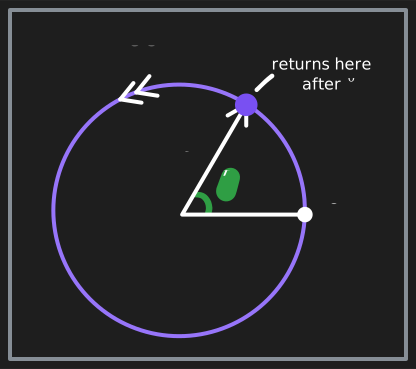
stores both its length and starting/phase angle (u can think of it as its “initial position”):
- (radius)
- (phase angle)
Visual Form: A rotating vector that returns to its start after period .
In Signal Analysis, smart ppl noticed that if you combine random signal blocks, the result is usually a meaningless, chaotic wave that never repeats itself. But they noticed that some building blocks work together perfectly. When you stack these specific blocks together, the result is a clean signal that also repeats over and over (is periodic). ^argh They investigated what these “compatible” blocks had in common (cuz clean is good) and noticed a pattern: their frequencies () weren’t random; they were all integer multiples of a single “base” frequency (). In other words, they were harmonically related.
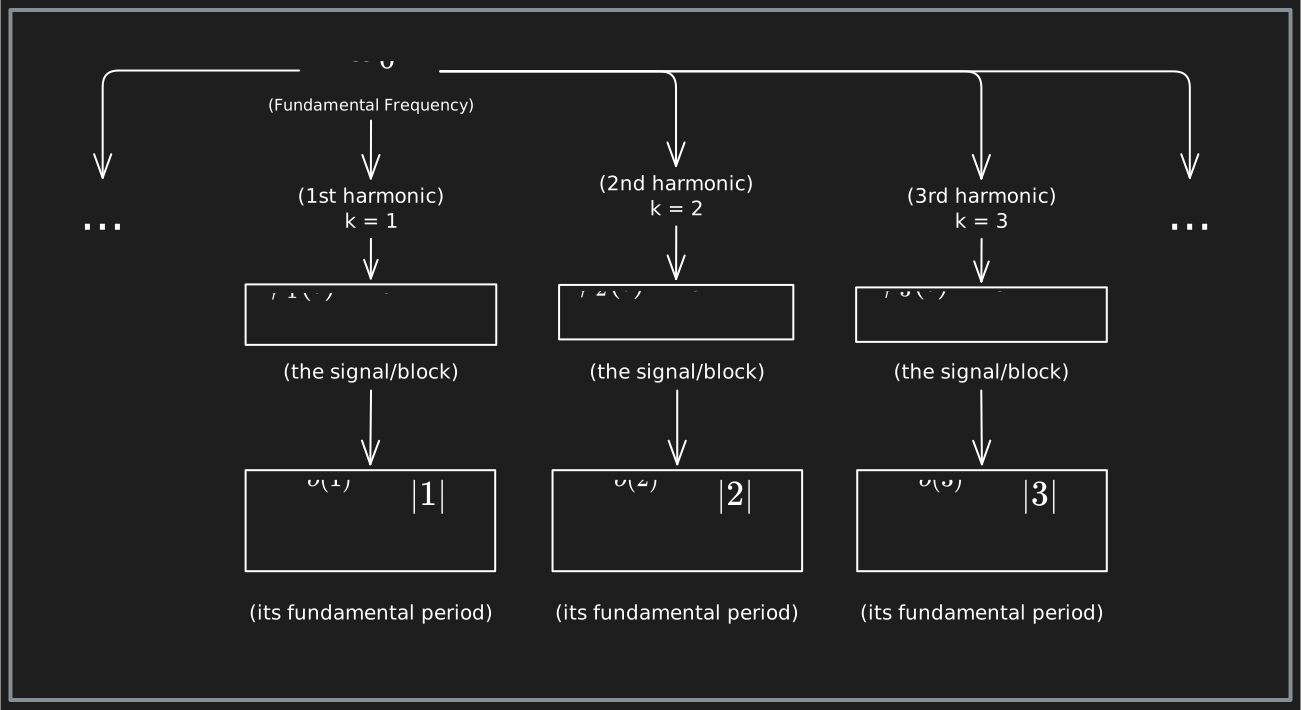
Now that they had a way to identify blocks that play nice together, they grouped them into families based on that shared . In an -family, the -th member (harmonic) has a frequency of and takes the form:
Also, its fundamental period is times smaller than their shared period ().
This diagram shows how a family of Periodic Complex exponentials with some () looks like.
Visual
The tool below shows how different harmonics “build” up a signal ) over time (the time axis extends down against the real values of the signal, and to the right against the imaginary values of the signal).
The visualization shows a complete period of x(t), and since its fundamental period was set to seconds, it runs for that long
You can use this tool to actually “see” what a signal that you’ve been solving a problem for looks like =)
Have fun.
Attribution
That tool was built by Kazad (over BetterExplained).
I simply took the source code and shamelessly vibe-coded it to make the visualization more intuitive to me.
Formal Definition
- a general complex exponential signal x(t)
- the kth harmonic of fund freq