What it is
Say you have a dataset of pet drawings, but the “cat” class is severely under-represented. You’ve got plenty of examples showing what a frog and a dog look like, but only a single example showing what a cat is.
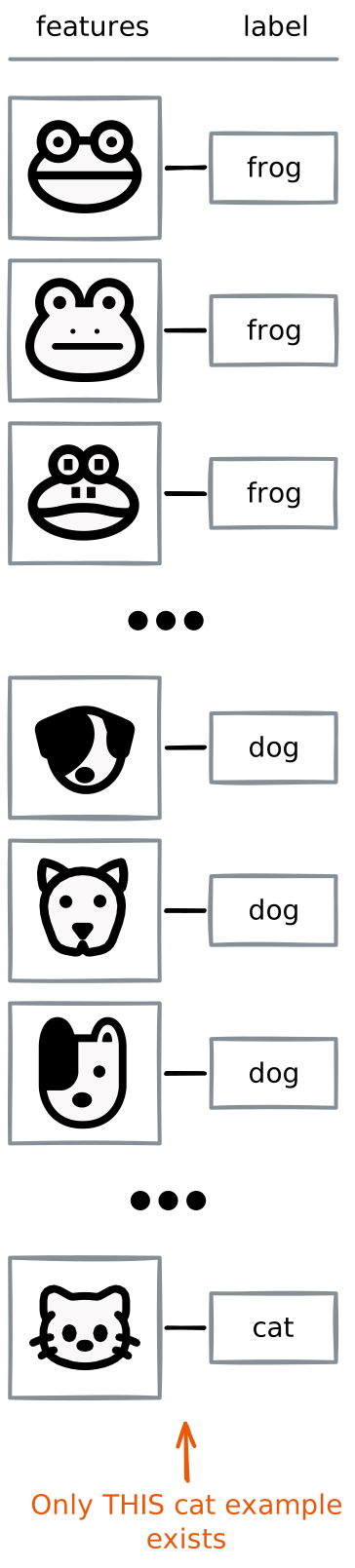
Is there anything u could do?
Sure there is: synthesize new examples for cats by milking your knowledge about what a “cat” is.
A cat with a head patch is still a cat, a cat with a drawn mouth is still a cat, a cat drawn smaller is still a cat. If u construct these variations, you can add add them all as new cat examples to the dataset.
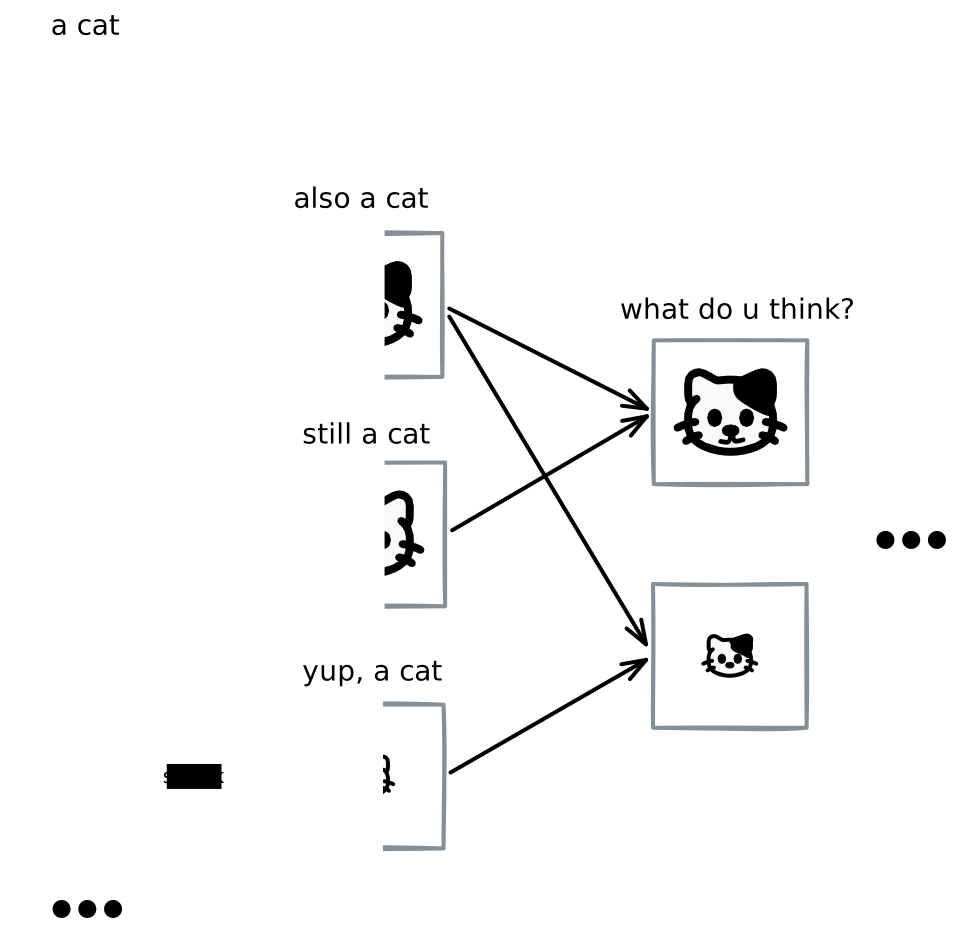
After adding 3 variations of what a cat is and combining some of them we ended up with 5 more training examples, imagine just how many more we can synthesize if we continued further.
However, there are rules that govern what variations are valuable and how they can be combined.
The “Still a Cat” Rule (Label Preservation)
The most critical rule of data augmentation is ensuring Label-Preserving Transformations. The variations you apply must never change the fundamental identity (the label) of the example.
An Example
- Good: Flipping a picture of a cat horizontally. It’s still a cat.
- Bad: Flipping the number “6” vertically. It becomes a “9” and is no longer a valid representation of the original class.
Common Techniques (Computer Vision)
When dealing with image data, you can combine multiple transformations to artificially expand your dataset:
- Geometric Transformations
- Scaling or Cropping Zooming in or cutting out parts of the image (forces the model to recognize partial features).
- Flipping Horizontal flips are usually safe; vertical flips depend on the context (e.g., upside-down cats are rare).
- Rotation or Translation Shifting the object off-center or tilting it.
- Color Space Adjustments
- Changing brightness, contrast, saturation, or hue. A dark photo of a cat is still a cat.
- Noise Injection
- Adding random Gaussian noise to pixels. This prevents the model from memorizing exact pixel values and forces it to look for broader patterns.
Other Usages
Apart from balancing a dataset, it can be used as a:
- Regularizer
By constantly feeding the model slightly altered images, it helps a model reduce its Overfitting. The model is forced to learn the general features of a cat (ears, whiskers) rather than memorizing the exact training images. - Generalization Booster
Makes a model less sensitive to real-world camera noise, lighting changes, and object positioning.